


The right hat isn’t simply a larger size. It should sit naturally on your head and feel comfortable to wear. If standard hats pinch at the band or perch too high, a size label alone may not explain why. Crown depth, head shape, and the way you want the brim to frame your face all matter. Finding custom hats for large heads starts with fit, not compromise.
A thoughtfully designed custom hat takes measurements and proportions into account from the start. Knowing what to measure, which fit preferences to share, and how design details affect comfort can help you make a more informed choice. The goal is a hat that feels at ease and looks like it belongs to you.
This guide covers practical measuring tips, the role of crown shape and depth, and how personal design choices complete the fit. At Busto & Sun, you can personalize a custom-made hat through an online hat quiz or an in-person fitting in Topanga Canyon. A few clear observations can help you get started.
Key Takeaways
- Measure around your head with a flexible tape held level above your ears, then note where existing hats feel tight or sit too high.
- Look beyond circumference: crown depth and overall shape can affect comfort as much as the size label.
- Compare ready-to-wear, adjustable, and custom-made options by how well they suit your proportions, fit preferences, and personal style.
- Bring your measurements, fit concerns, preferred styles, and intended use to a custom hat fitting.
- Custom hats for large heads can bring fit and personal design together. Busto & Sun’s online hat quiz is one way to begin shaping your hat.
Why custom hats for large heads need more than a bigger size
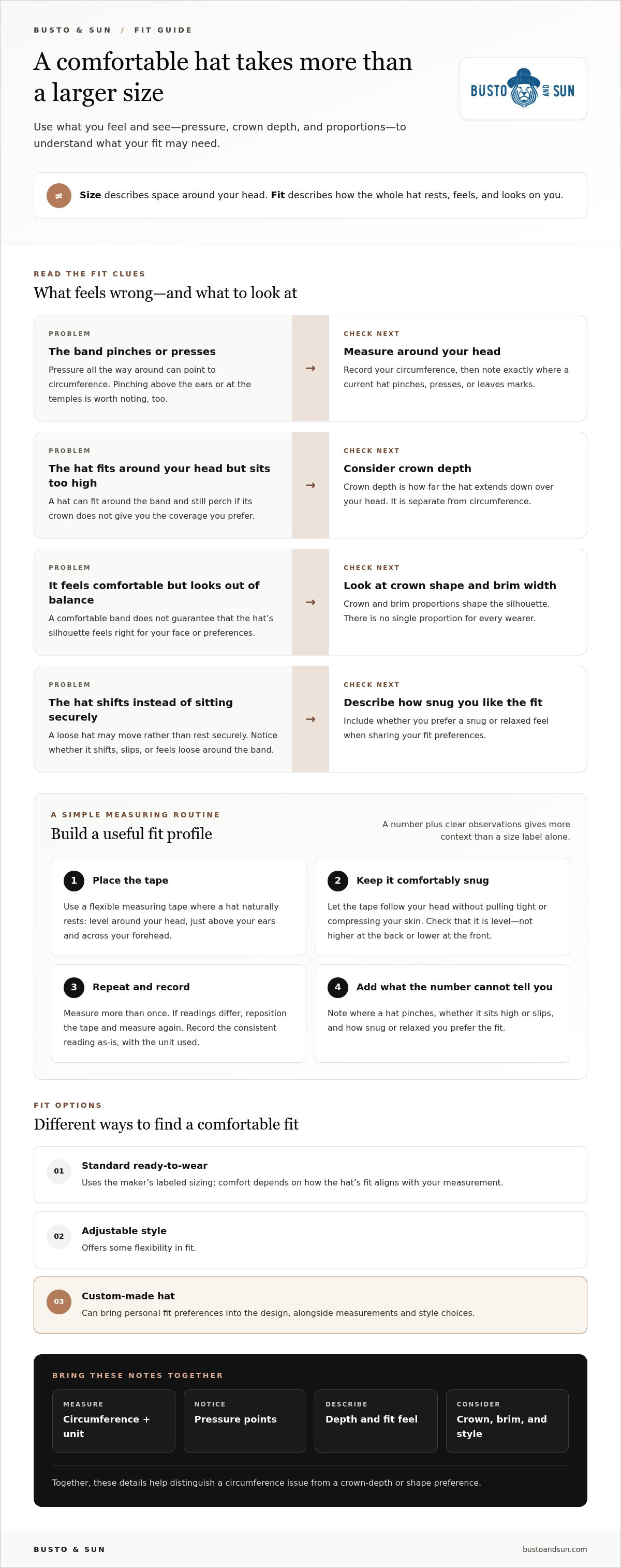
A hat can be roomy enough around the band and still feel wrong. It might press at the temples, pinch above the ears, or sit so high that it looks perched. That’s because comfort depends on more than circumference. Crown depth, head shape, and the hat’s proportions also affect how it rests and looks.
Hat size describes the space around your head; fit describes how the whole hat rests, feels, and looks on you. That distinction matters when choosing custom hats for large heads. Moving up a size may ease pressure around the band, but it won’t necessarily add crown depth or change how the silhouette frames your face.
What makes a hat feel too small or out of proportion?
Circumference affects pressure around your head. A band that’s too snug can pinch, while a loose hat may shift instead of sitting securely. Crown depth affects how low the hat sits: a shallow crown may ride high, while a deeper crown may provide more coverage. Brim width and crown proportions also shape the silhouette. The history of hats and their various forms shows just how varied hats can be in shape and purpose. There’s no single proportion for every wearer.
Why fit matters as much as style
A hat that feels secure without pinching is easier to wear for longer stretches, whether you’re out in the sun or making it part of your everyday look. Comfort supports style: when a hat feels good, it’s more likely to become one you reach for. A well-proportioned crown and brim can make the design feel intentional, rather than simply larger to accommodate circumference. The right proportions depend on your features and preferences.
Pay attention to the difference between pressure and proportion. If the band feels tight all the way around, circumference may be the main issue. If the fit around your head feels comfortable but the hat sits high, crown depth may be a better place to focus. If it fits comfortably but looks out of balance, consider how the crown shape and brim width work together. These observations reveal more than a size label can.
Custom design can bring measurements and personal proportions into the same conversation. Instead of treating a larger size as the whole answer, consider how you want the hat to sit, what feels comfortable, and which silhouette feels like you. The aim is a hat that feels considered from the inside out, with a comfortable fit and a shape that suits your style.
How head measurements and hat shape work together
A useful fit note is more than a number. Pair your head circumference with observations about how hats sit and feel, and you’ll have a clearer starting point for choosing or shaping a hat. Measure around your head, note pressure points, assess crown depth, and record your preferred fit. Repeat the measurement rather than guessing from a size label.
How to measure your head before choosing a hat
Use a flexible measuring tape and place it where a hat naturally rests: level around your head, just above your ears and across your forehead. Keep the tape comfortably snug, not pulled tight. It should follow your head without compressing your skin. Check that it hasn’t slipped higher at the back or dipped at the front.
Take the measurement more than once. If the readings differ, reposition the tape and measure again. Record the consistent reading as-is instead of converting it into a guessed hat size. The hat size chart guide explains how measurements relate to sizing.
- Record your circumference and the unit you used.
- Note where a current hat pinches, presses, or leaves marks.
- Describe whether it sits too high, slips, or feels comfortable.
- Write down how snug or relaxed you like the fit to feel.
These observations turn a measurement into a useful fit profile. “Tight” is a start; “pressure above my ears after a short time” gives a more specific clue.
How crown depth and head shape affect comfort
Circumference measures around your head. Crown depth describes how far the hat extends down over it. They’re separate dimensions: a hat may fit around the band but perch high if its crown doesn’t provide the coverage you prefer. Head shapes and wearing preferences vary, so two people with the same circumference may want different proportions.
Pay attention to how a hat behaves, not just what it measures. Does the crown press at the top, or does the hat sit securely but feel shallow? Does the crown seem right while the band feels loose? Note whether it pinches, perches high, or shifts. Those details help distinguish a circumference issue from a depth or shape preference.
The CDC’s CDC growth charts for head circumference reference children’s growth, not adult hat sizing, so they aren’t a substitute for measuring your own head. For practical hat sizing, use your measurement and fit notes together, then compare them with the hat size chart guide. To begin shaping a custom fit, use Busto & Sun’s online hat quiz to share your preferences.
Compare hat fit options for a larger head before you choose
There’s more than one way to find a comfortable hat. Ready-to-wear sizing may work well, an adjustable style can offer some flexibility, and a custom-made hat can bring your personal fit preferences into the design. Start with what you actually experience: does a hat stay in place comfortably, or does it pinch, ride high, or feel out of balance?
| Fit option | Circumference | Crown proportions | Adjustability | Personal style |
|---|---|---|---|---|
| Standard ready-to-wear | Uses the maker’s labeled sizing; comfort depends on how the hat’s fit aligns with your measurement. | Set by the design, so depth and shape may or may not suit your preferences. | Usually limited to the fit built into that style. | Choice comes from available designs and sizes. |
| Adjustable styles | A closure can allow some circumference adjustment, depending on the hat’s design. | The crown’s depth and shape remain part of the original design. | Offers a way to fine-tune the fit, but won’t address every proportion concern. | Style options depend on the design. |
| Custom-made fitting | Personal measurements can inform the fit. | Crown and overall proportions can be considered alongside fit preferences. | Fit is considered through the custom process rather than relying only on an adjustment feature. | Personal preferences help guide the design. |
When a size label doesn’t explain how the hat sits, your measurements and fit preferences are the more useful guide. That’s especially true if the circumference seems close but the crown feels shallow, or the hat feels secure yet looks out of balance. A label describes a sizing category, not the full experience of wearing the hat.
When standard sizing or an adjustable fit may be enough
Ready-to-wear sizing can work well when a hat feels comfortable and stays in position without pressure. An adjustable closure may help fine-tune circumference, but it won’t automatically change crown depth or shape. Not every adjustable hat will suit every head, so consider how it feels and sits, not just the label.
When a custom-made hat offers a more personal route
If standard options keep missing the mark, a custom process can consider your measurements alongside the fit you prefer. Crown shape, brim proportions, and the silhouette you want can inform the design, bringing comfort and character into the same conversation. Busto & Sun creates handcrafted bespoke hats, with an online hat quiz and in-person fittings as ways to begin. The custom-made hat commissioning guide offers a closer look at the process.
Compare each option against your specific fit concern. If circumference is the main issue and a ready-to-wear hat feels secure, standard sizing may be enough. If a closure helps but the crown still sits too high, adjustment alone may not solve the problem. With custom hats for large heads, measurements, proportions, and personal style can all inform the design, rather than relying on a larger size label to address everything.
Prepare for a custom hat fitting with clear measurements and preferences
A fitting is more useful when you bring specific observations, not just “my hats don’t fit.” Think of it as sharing a quick map of what works, what doesn’t, and how you hope to wear your hat. Measurements give you a starting point; your experiences and preferences add context.
Before a fitting, gather:
- Your head measurement: Record your circumference and the unit you used.
- Fit problems: Note where hats feel tight, loose, shallow, or unstable.
- Style preferences: Consider crown height, brim proportions, and the overall character you’re drawn to.
- Intended use: Think about when and where you expect to wear the hat, such as everyday outings or time outdoors.
If you have a familiar hat that fits well, bring it as a reference. A hat that fits poorly can also help illustrate a particular issue, such as pressure at the temples or a crown that sits higher than you like. It doesn’t need to be a perfect example to help explain your preferences.
What to note about comfort and everyday wear
Be specific about where discomfort begins. “It feels tight” is helpful; “it presses above my ears” gives a clearer picture. Describe whether a hat feels loose around the band, shallow over the top, or as if it perches too high. Consider how long you typically wear a hat and in what setting. These details connect your fit preferences to how you’ll use it.
How to describe the look you want
Think about the silhouette as a whole. Do you prefer a higher- or lower-looking crown, an understated or more pronounced brim, or a relaxed or structured character? There’s no universal answer. Reference images can help communicate what catches your eye, especially if you can explain what you like about each one. Use them as inspiration rather than a demand for an exact copy.
A custom fitting is a collaboration between wearer and maker. Share your measurements, comfort notes, and visual references, then discuss how they might come together in a hat that feels personal. For custom hats for large heads, that conversation can keep circumference, proportions, and style in view at the same time.
Busto & Sun offers in-person custom fittings in Topanga Canyon, in the Los Angeles area, and creates handcrafted bespoke hats there. To learn more before a fitting, explore the custom hat design guide. When you’re ready, explore custom hat design and consider an in-person fitting.
Find your custom large-head hat fit with Busto & Sun in Los Angeles
A hat should feel like a natural extension of the person wearing it, not a compromise made to fit a size label. Busto & Sun creates handcrafted bespoke hats in Topanga Canyon, California, bringing Italian craftsmanship together with a California sensibility. If you’re looking for custom hats for large heads, begin with your preferences: how you want the hat to sit, which proportions feel right, and what character you want it to have.
A custom hat shaped around the person wearing it
Personal fit is part of the design conversation. Your measurements describe circumference, while notes about crown depth, pressure points, and preferred coverage give a fuller picture of how you want the hat to wear. Share what has felt uncomfortable in the past and what you’d prefer instead. Those details help guide a considered discussion of fit and silhouette.
Custom design also makes room for personal style. You might be drawn to a certain crown height, a particular brim proportion, or a shape that feels at home in your daily life. There’s no single look every wearer should choose. Busto & Sun’s bespoke approach brings individual preferences together with Italian craftsmanship and a California point of view. The hats are designed and produced in Topanga Canyon.
Begin your custom hat experience in Topanga Canyon
For readers in the Los Angeles area, an in-person custom fitting is an opportunity to discuss measurements and proportions directly. Bring your fit notes, along with a familiar hat or visual references if they help explain what you have in mind. A fitting gives you space to talk through how you want your hat to sit and look.
If you prefer to start online, Busto & Sun’s hat quiz offers a way to begin personalizing a hat. Share your preferences and start shaping an idea that feels distinctly yours. Whether you begin with a fitting in Topanga Canyon or the quiz, the goal is to bring fit and personal expression into the design process.
Explore the custom-made hat journey to learn more about commissioning a bespoke piece. Ready to start imagining yours? Explore custom hats with Busto & Sun.
Make room for a hat that feels like yours
Your next hat can begin with a simple shift in perspective: instead of trying to fit a standard label, start with how you want the hat to feel. Consider the comfort you’re after, the shape you’re drawn to, and the role you want the hat to play in everyday life. Those choices give custom hats for large heads a personal starting point, grounded in your proportions and sense of style.
You don’t need every detail decided before you begin. Bring a few clear preferences, stay open to the conversation, and let the design take shape thoughtfully. A well-chosen hat can become part of the places you go and the stories you carry.
Ready to explore a hat made with personal fit and character in mind? Start with Busto & Sun’s custom hat quiz and begin shaping a hat that feels at home on you.
Frequently Asked Questions
What hat size is considered large?
There’s no universal cutoff for a “large” hat size because labels and sizing ranges differ among makers. Treat “large” as a useful search term, not a measurement. Record your head circumference and compare it with the specific maker’s sizing guidance. Also note how hats feel: if a labeled size fits around your head but the crown feels shallow, that matters too.
Can a wide-brim hat look balanced on a larger head?
Yes. Balance depends on how the brim and crown relate to each other and to your features, not on head size alone. A wide brim can create a confident, dramatic silhouette, while a narrower proportion may feel quieter. View the hat with the clothes you expect to wear it with and consider your usual setting. The right choice is the one that feels natural to you.
Does a hat size mean the same thing across every brand?
No. A size label from one maker may not translate exactly to another maker’s sizing system. Use your measured circumference as a comparison point, then read the sizing guidance for the specific hat you’re considering. Keep a note of sizes that felt comfortable and whether the crown sat as you liked. That record can make future online shopping less uncertain.
Can long or thick hair change how a hat fits?
Yes. Hair volume and styling can affect how a hat rests, especially if you switch between wearing your hair down and gathering it up. A hat that feels comfortable with your hair loose may sit higher or feel tighter over a bun. Measure and assess the fit with the hairstyle you expect to wear most often, and mention other regular styles during a fitting.
Should a new hat feel snug or loose?
A hat should feel secure without painful pressure, persistent pinching, or slipping during ordinary movement. The ideal feel varies with the hat’s design and your preference, so there isn’t one exact level of snugness for every style. Move naturally while wearing it. If pressure builds at your temples or the hat shifts when you turn your head, describe that clearly during a fitting.
Do all custom hats use the same fitting process?
No. Custom hatmaking methods vary, so don’t expect every maker to follow the same sequence. Make the conversation useful by bringing your measurements, describing what you’d change about hats you already own, and explaining the silhouette you’re after. For example, you might want a familiar look with more room at the crown. Clear preferences help keep the discussion centered on your needs.
Can I wear sunglasses comfortably with a fitted hat?
Often, but comfort depends on how your glasses sit with the hat’s crown and brim. Try them together as you’d wear them outdoors. Notice any pressure where the arms meet your temples and whether putting the glasses on shifts the hat. If you’re considering custom hats for large heads, include regular eyewear in your fit notes, especially if you wear sunglasses for long stretches around Los Angeles.