


A hat shouldn't just sit on your head. It should belong there. You've likely felt the biting pinch of a headband that's too tight or the constant anxiety of a gust of wind claiming your investment. Luxury labels often fail us with rigid, standard sizing that leaves red marks on the skin. When you're investing in quality, you need to know exactly how should a bespoke hat fit to avoid these common frustrations. A true masterpiece is never one-size-fits-all. It's a vessel for your story.
The perfect fit is a soulful harmony between the hat's geometry and your unique spirit. It's about more than just a measurement. It's about the way the felt breathes and the way the brim frames your world. We'll guide you through the nuanced sensory markers of artisanal comfort. Discover how Italian heritage and the free-spirited energy of Topanga Canyon come together to create a fit that feels like a second skin. We'll explore the technical precision of the French conformator and the intuitive settling of high-quality felt to ensure your next piece is a perfect, enduring investment.
Key Takeaways
- Discover the nuanced sensory markers that define how should a bespoke hat fit, moving beyond simple circumference to achieve a soulful, second-skin harmony.
- Learn why standard luxury labels often fail the artisanal standard and why metric precision is the only way to ensure a lifetime of comfort.
- Master the "One Finger" rule and vertical placement techniques to find the perfect balance between security and ease.
- Understand how head geometry and high-quality materials like Italian felt dictate the way your hat matures and settles over time.
- Explore the ritual of a Topanga fitting, where historical Italian heritage meets the free-spirited energy of the California coast.
The Difference Between Wearing a Hat and Finding Your Fit
A hat is more than a simple accessory. It's a quiet, tactile conversation between the material and the wearer. When you ask how should a bespoke hat fit, you're looking for more than a measurement on a tape. You're seeking a tailored interaction between your unique skull and the hand-shaped felt. Standard "Small, Medium, or Large" labels are built for the global average. They treat the head as a geometric sphere rather than a landscape of unique curves and ridges. In the world of traditional hand-craftsmanship, we look for the soul of the fit. A hat that merely sits on the head feels like a burden, while a hat that fits perfectly feels like a part of your own body.
The psychological shift is profound. When a hat fits, you stop thinking about it. You move with a different kind of confidence. It becomes a wearable legacy, a vessel for your stories that matures alongside you. It doesn't just rest on you; it belongs to you. Understanding how should a bespoke hat fit means recognizing that your head is a unique landscape that deserves more than a mass-produced compromise.
The 'Halo' vs. The 'Grip'
There's a specific tension to master. A "halo" fit is one where the hat floats, barely touching the temples. It looks fine in a mirror, but it's a liability in the unpredictable California wind. One gust through the canyon and your investment is gone. Conversely, a true "grip" isn't about constriction. It's about a firm, even pressure that distributes weight across the entire circumference. You shouldn't feel a single pinch point or a red mark on your forehead. It's a secure embrace, not a headache. A Custom Made Hat should feel like it's holding your hand, not squeezing your wrist.
Why 'Off-the-Rack' Often Falls Short
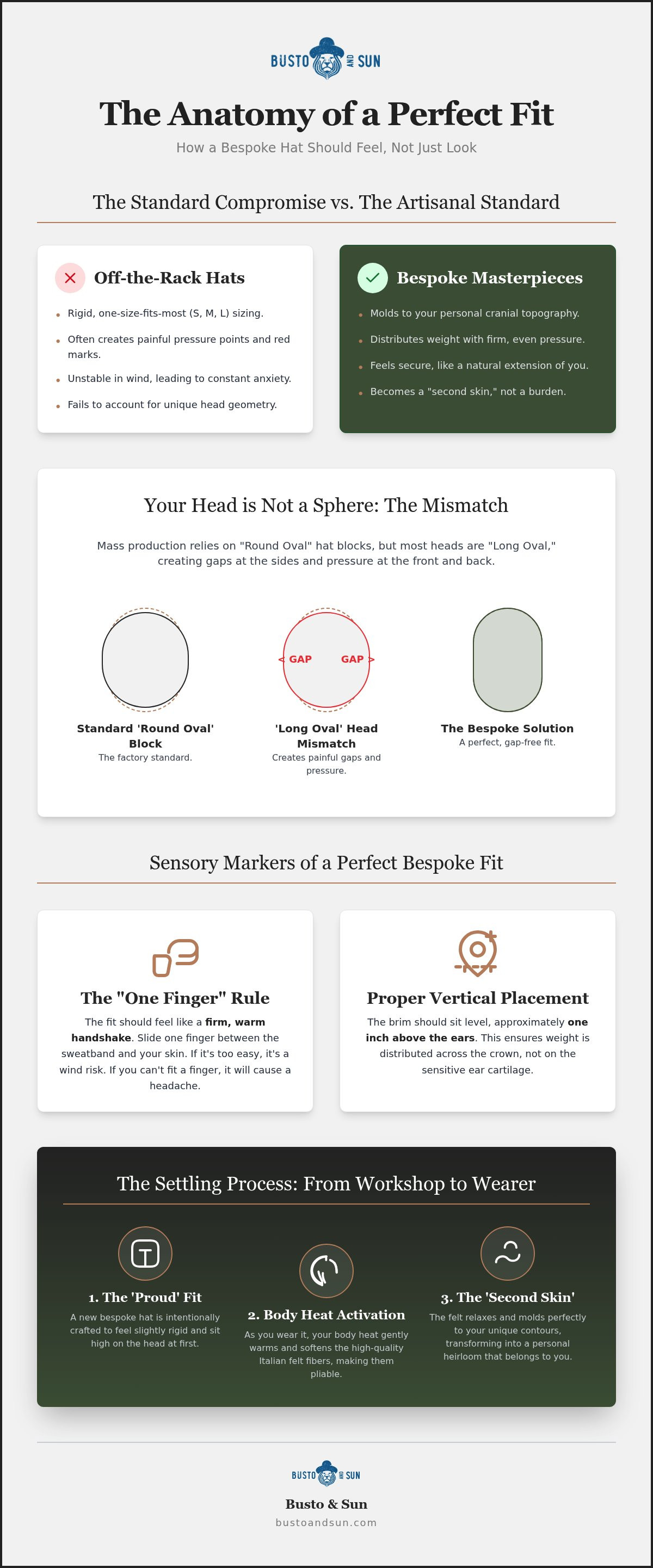
Mass production relies on "Round Oval" blocks to satisfy the widest possible audience. Most people, however, possess a "Long Oval" or "X-Long Oval" head shape. This mismatch creates the dreaded temple gap, where the hat is tight at the front and back but leaves hollow spaces at the sides. It creates a silhouette that looks clumsy and feels unstable. Bespoke makers like Busto & Sun account for these individual cranial nuances. We use tools like the French conformator to map the exact topography of your head. This ensures the hat honors your specific shape, whether you're navigating the streets of Los Angeles or the rugged trails of Topanga.
The Sensory Markers of a Perfect Bespoke Fit
Understanding how should a bespoke hat fit requires a shift from the clinical to the sensory. It's an intuitive recognition of balance. While mass-produced guides often tell you to determine your hat size using a static chart, a bespoke piece demands a more intimate assessment. The first marker is the level of the brim. Your hat should sit level on your head, neither diving toward your eyes nor tilting back in a way that suggests instability. It should feel like a natural extension of your brow, resting approximately one inch above the ears. This specific clearance ensures the weight is distributed across the crown rather than irritating the sensitive cartilage of the ear.
The "One Finger" rule is your most reliable tactile guide. When the hat is seated, you should be able to slide a single finger between the leather sweatband and your skin. It should feel like a firm, warm handshake. If the finger slides in too easily, the hat will likely shift in the California wind. If you can't fit the finger at all, you're looking at a future headache. This balance of space and contact is the hallmark of a master hatter's work.
The Settling Process: From Workshop to Wearer
A new bespoke hat often feels slightly "proud" when you first place it on your head. This is intentional. High-quality Italian felt is a living material with a memory. As you wear it, your body heat acts as the final tool in the hatter's workshop. The fibers begin to soften and mold to the unique topography of your skull. Within the first few hours of intentional wear, the felt relaxes. It loses that initial rigidity and begins to mirror your contours. This settling process is what transforms a beautiful object into a personal heirloom that fits like a second skin.
Identifying the 'Pinch Points'
There's a vital distinction between a secure fit and a restrictive one. A secure fit stays put as you move through Topanga Canyon, yet it never leaves a deep red mark on your forehead. True bespoke craftsmanship eliminates the "hat headache" by removing the uneven pressure points found in factory-blocked hats. You shouldn't feel the material biting into your temple or pressing against the occipital bone at the back of your head. If you're unsure about your own cranial nuances, taking a custom hat quiz can help bridge the gap between a standard size and a soulful fit. A perfect hat provides a consistent, gentle embrace across the entire circumference, ensuring comfort that lasts from sunrise to the last light of the Pacific.
Material and Geometry: Why Felt, Straw, and Shape Matter
Geometry is destiny. While a standard manufacturing block assumes a perfect circle, the reality of the human form is far more complex and elongated. When we discuss how should a bespoke hat fit, we're really discussing the invisible architecture of the oval. Most off-the-rack hats are built on "Round Oval" blocks, a global average that rarely honors the individual. A master hatter works with three primary geometries: Round Oval, Long Oval, and X-Long Oval. Choosing the wrong one results in a hat that feels like a vice on the forehead while leaving hollow, unstable gaps at the temples. It's a fundamental mismatch that no amount of "breaking in" can truly fix.
The material itself dictates the lifespan of that fit. High-quality Italian beaver blends possess a natural resilience. These fibers are supple yet strong, holding their intended shape for decades. Wool, by contrast, is often brittle. It lacks the "memory" of premium fur felt and is prone to irreversible shrinkage when exposed to the elements. The sweatband acts as the final interface. A traditional leather sweatband is non-negotiable for a true bespoke experience. Unlike fabric alternatives, leather breathes and slowly conforms to your cranial topography, creating a seal that feels intentional and secure.
The Long Oval Struggle
Many industry professionals observe that a significant majority of Western wearers possess a "Long Oval" head shape. This leads to a persistent dilemma: the "side-pinch" versus the "front-gap." In a standard hat, you're forced to size up to accommodate the length of your head, which leaves the sides feeling loose and sloppy. How Custom Made Hats solve this is through precision blocking. We shape the felt to your specific ovality from the very beginning. This ensures the pressure is distributed evenly, eliminating the gaps and providing a silhouette that looks as sharp as it feels.
Climate and Fit: The Topanga Factor
Environment is the silent shaper of your hat. In the unique microclimate of Topanga Canyon, humidity and the intense California sun play a constant tug-of-war with natural fibers. Moisture can cause felt to swell slightly, while dry heat may cause it to tighten. Precision is even more critical with straw and Panama hats, which offer almost zero "give" compared to felt. To maintain fit integrity, you must choose the right weight for your lifestyle. A lightweight summer felt offers breathability, while a heavy winter beaver provides the substance needed for rugged use. Proper storage in a Busto & Sun Hatpack ensures your piece remains protected from the warping effects of heat and gravity, preserving the perfect fit for a lifetime.
Measuring for Mastery: Finding Your 7 5/8 or Metric Equivalent
Precision is the technical foundation of a soulful fit. In the workshop, we speak the language of centimeters because it offers a level of accuracy that imperial fractions often obscure. When you ask how should a bespoke hat fit, you're asking for a measurement that honors the millimeter. A standard size like 7 5/8 is a helpful label, but 60.6 cm is a reality. This metric precision allows us to account for the quiet alchemy between your head and the felt. Without it, you're left with a generic approximation that ignores the unique topography of your skull.
The tools you choose define the outcome. A rigid metal tape or a plastic ruler will fail you. You need a soft tailor's tape that can curve around your life and your form. We utilize the "Three-Measure" method to find the truth. By measuring three separate times and finding the consistent median, we eliminate the variables of hair volume or slight tape slips. This ensures the final piece doesn't just sit on your head. It settles there with intention. Understanding these numbers is the first step toward a Custom Made Hat that feels like an heirloom from the moment you put it on.
Step-by-Step DIY Measurement
Begin by placing the tape at the widest part of your skull. This is usually about half an inch to an inch above the ears, right where the hat's sweatband will naturally rest. Pull the tape snug but not tight. It should feel exactly like a comfortable headband. Don't let it bite into the skin. Record the measurement to the nearest millimeter. If you find yourself between two marks, always round up. It's easier for an artisan to add a subtle shim than to stretch a finished crown beyond its intended geometry.
The 7 5/8 Deep Dive
For those with larger head sizes, the 60.6 cm conversion is a vital benchmark. However, a hat size chart is only the starting point of the conversation. Mastery lies in the relationship between your head size and the visual proportions of the hat. A 7 5/8 head requires a specific crown height and brim width to maintain the "Golden Ratio." If the brim is too narrow, the hat looks small. If the crown is too low, it looks compressed. We balance these elements to ensure your hat frames your face with the same grace it provides your brow. Find your perfect fit by taking our custom hat quiz today.
The Topanga Fitting: Crafting an Heirloom with Busto & Sun
The journey to a perfect fit ends in the heart of Topanga Canyon. Here, the air carries the scent of sage and the steady hum of ancient machinery. A Busto & Sun fitting is an intentional pause in a fast-paced world. It's a ritual where historical Italian heritage merges with the rugged, free-spirited energy of the California coast. When you step into our studio, you aren't just buying an accessory. You're commissioning a vessel for your own story. The question of how should a bespoke hat fit is finally answered not through a chart, but through the intuitive touch of a master hatter. It's a collaboration between maker and wearer.
Every hat we create is a bridge between generations. We treat the material with a reverence learned in the old country, yet we shape it for the modern traveler. This is where the technical precision we've discussed meets the soulful reality of your life. It's about a hat that feels as comfortable on a dusty canyon trail as it does on a city street. It's a piece of art that understands the movement of your body and the spirit of your journey.
The Ritual of the Appointment
A Los Angeles fitting session is a tactile exploration of quality. You'll feel the weight of high-quality Italian felt and choose between finishes that range from ruggedly distressed to elegantly refined. The process is visceral. We use fire and steam to manipulate the fibers, a dance of elements that locks in your unique fit. This final shaping ensures the hat honors the exact topography of your skull. It's a moment of transformation where the felt finally accepts its new home, settling into a shape that is yours alone.
Ordering with Confidence
Distance shouldn't be a barrier to quality. Our Custom Hat Quiz acts as a digital bridge, allowing our online tools to replicate the master hatter's eye. We've designed this experience to capture the nuances of your style and head shape from anywhere in the world. Every Busto Signature Topanga Hat comes with a commitment to longevity. We ensure your piece fits for generations, becoming a wearable legacy of freedom. From the hand-sewn ribbons to the soul of the brim, every detail is finalized with intention. We don't just deliver a product. We deliver a piece of Topanga that will age beautifully alongside you. Understanding how should a bespoke hat fit is the beginning of a lifetime investment in your own personal narrative.
Embrace Your Wearable Legacy
A hat is more than felt and thread. It's a vessel for your personal story, a companion for your adventures through the canyons and beyond. We've explored the tactile markers of quality, from the "One Finger" rule to the precision of metric measurements. You now understand that how should a bespoke hat fit is a question of soul as much as geometry. It's the difference between a mass-produced accessory and a handcrafted heirloom that breathes with you. It's about finding that perfect balance where the material honors your unique form without a single point of restriction.
Our process honors an Italian craftsmanship heritage while embracing the wild, intentional spirit of Topanga Canyon. Whether you join us for a bespoke fitting in Los Angeles or connect with us from afar, we're here to ensure your piece feels like a second skin. Your journey toward a perfect fit doesn't have to be a mystery. It's a ritual of self-expression that starts with a single, intentional step. Find your soulful fit with our Custom Hat Quiz and begin your legacy today. The horizon is waiting, and your hat should be ready to meet it.
Frequently Asked Questions
How tight should a bespoke hat feel when I first put it on?
Your hat should feel secure, not restrictive. It should mirror the pressure of a comfortable headband when you first put it on. Over the first few hours of wear, your body heat helps the Italian felt relax and settle against your unique contours. If you feel a sharp pinch or a headache within minutes, the fit is too tight. A true bespoke piece provides a consistent embrace across the entire circumference of your head.
Can a bespoke hat be adjusted if my hair length changes?
Significant changes in hair volume can alter the tactile experience of your fit. A close buzz cut versus a full mane can change your measurement by several millimeters. While high-quality felt has a small amount of give, it's designed to honor the specific topography measured during your Los Angeles fitting. If you plan on a major style change, it's best to measure your head at its most common hair length to ensure long-term comfort.
What is the difference between a 7 5/8 hat and a 61 cm hat?
The primary difference lies in the precision of the measurement. A 7 5/8 label is a traditional imperial size that covers a range, while 61 cm is a specific metric value. In reality, a true 7 5/8 is closer to 60.6 cm. When determining how should a bespoke hat fit, we prefer centimeters because they eliminate the guesswork of fractions. This ensures your Custom Made Hat aligns perfectly with your physical reality.
How do I know if I have a Long Oval head shape?
You can identify a Long Oval shape by observing how standard hats interact with your temples. If off-the-rack hats feel tight on your forehead but leave hollow gaps at the sides, you likely have a Long Oval head. This is the most common shape for Western wearers. At our Topanga studio, we use a French conformator to map these exact nuances, ensuring your brim stays level without the dreaded side-pinch or instability.
Will my bespoke felt hat stretch or shrink over time?
High-quality felt is a living material that settles rather than stretches. While wool hats often shrink when exposed to the California sun, our premium Italian beaver blends are designed for longevity. They will relax to your head shape during the first week of wear, but they won't lose their structural integrity. Proper storage in a Busto and Sun Hatpack is essential to protect the fibers from warping or contracting over many years.
How should a wide-brim cowboy hat sit compared to a fedora?
A wide-brimmed cowboy hat typically sits lower and firmer to withstand the wind of the open canyon. It relies on a deeper grip to stay secure during movement. A fedora is often worn with a more delicate balance, resting about one inch above the ears to frame the face. Both styles should feel like a second skin, but the cowboy hat prioritizes utility while the fedora emphasizes a soulful, intentional silhouette and light touch.
What should I do if I am between two sizes on the chart?
Always round up to the nearest millimeter if you find yourself between two sizes. It's far easier for an artisan to add a subtle leather shim behind the sweatband than it is to stretch a finished crown. Stretching can distort the geometry of the brim and weaken the felt fibers. Choosing the slightly larger size ensures we can fine-tune the fit during your personal appointment to achieve the absolute comfort required for a lifetime investment.
Does the weight of the felt affect how the hat fits?
The weight of the material plays a significant role in the sensory experience of the fit. A heavy, high-beaver-content felt feels substantial and structural, offering a more rigid grip on the head. Lightweight summer felts are more pliable and reactive to your body heat, allowing them to settle more quickly. We select the specific felt weight based on your lifestyle and the intended environment, whether that's a Los Angeles sunset or a rugged canyon trail.